<?xml version="1.0" encoding="utf-8"?><feed xmlns="http://www.w3.org/2005/Atom" xml:lang="en"><generator uri="https://jekyllrb.com/" version="3.10.0">Jekyll</generator><link href="https://jayavanth.github.io/feed.xml" rel="self" type="application/atom+xml" /><link href="https://jayavanth.github.io/" rel="alternate" type="text/html" hreflang="en" /><updated>2025-05-07T17:38:32+00:00</updated><id>https://jayavanth.github.io/feed.xml</id><subtitle>Made with &lt;b style=&quot;color: #f45;&quot;&gt;&amp;lt;3&lt;/b&gt; by &lt;b&gt;&lt;a href=&quot;https://github.com/niklasbuschmann&quot;&gt;@niklasbuschmann&lt;/a&gt;&lt;/b&gt;</subtitle><author><name>Jayavanth Shenoy</name></author><entry><title type="html">The Wordle Trap</title><link href="https://jayavanth.github.io/world-trap/" rel="alternate" type="text/html" title="The Wordle Trap" /><published>2022-03-19T00:00:00+00:00</published><updated>2022-03-19T00:00:00+00:00</updated><id>https://jayavanth.github.io/world-trap</id><content type="html" xml:base="https://jayavanth.github.io/world-trap/"><![CDATA[<p>Ever fell into this trap in Wordle?</p>

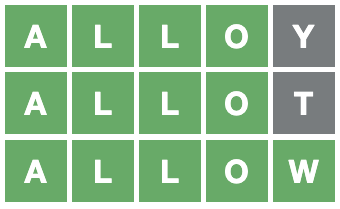
<p>You guess a word with 3 or 4 letters in the right place but you’re left with a lot of words that match that exact pattern. Example:</p>

<p><img src="/assets/wordle_trap.png" alt="trap" /></p>

<h2 id="average-number-of-words-with-same-n-letters">Average number of words with same n letters</h2>

<p>This situation commonly occurs with 3 or 4 letters in my experience. Turns out the average number of words with the same 4 letters is 3.048 and for 3 letters it’s 8.044.</p>

<p>You can try it out <a href="https://github.com/jayavanth/wordletrap">here</a>.</p>

<h2 id="what-should-you-do">What should you do?</h2>

<ol>
  <li>Break the trap: If you think there might be a lot of guesses, try to see if a completely different word with different letters with the one you got the hit reveals anything. For example, instead of continuing with ALLO words, try something like GUILT</li>
  <li>If you don’t want to do that, for 4 letter traps, if you have 3 attempts left, you should keep guessing since the average is 3.</li>
  <li>For 3 letters, it’s better to just break it since the average is 8.</li>
</ol>

<hr />]]></content><author><name>Jayavanth Shenoy</name></author><summary type="html"><![CDATA[Ever fell into this trap in Wordle? You guess a word with 3 or 4 letters in the right place but you’re left with a lot of words that match that exact pattern. Example: Average number of words with same n letters This situation commonly occurs with 3 or 4 letters in my experience. Turns out the average number of words with the same 4 letters is 3.048 and for 3 letters it’s 8.044. You can try it out here. What should you do? Break the trap: If you think there might be a lot of guesses, try to see if a completely different word with different letters with the one you got the hit reveals anything. For example, instead of continuing with ALLO words, try something like GUILT If you don’t want to do that, for 4 letter traps, if you have 3 attempts left, you should keep guessing since the average is 3. For 3 letters, it’s better to just break it since the average is 8.]]></summary></entry><entry><title type="html">Grouping Technique in Speed Reading</title><link href="https://jayavanth.github.io/speed-reading/" rel="alternate" type="text/html" title="Grouping Technique in Speed Reading" /><published>2020-09-19T00:00:00+00:00</published><updated>2020-09-19T00:00:00+00:00</updated><id>https://jayavanth.github.io/speed-reading</id><content type="html" xml:base="https://jayavanth.github.io/speed-reading/"><![CDATA[<p>Speed Reading is a collection of techniques used to read text faster without sacrificing comprehension<sup id="fnref:1" role="doc-noteref"><a href="#fn:1" class="footnote" rel="footnote">1</a></sup>.</p>
<p>Grouping is a technique in speed reading where instead of reading one. word. at. a. time, you read words in groups. The method is similar to what we call n-gram<sup id="fnref:2" role="doc-noteref"><a href="#fn:2" class="footnote" rel="footnote">2</a></sup> in NLP, and it’s used as a sampling technique. In the context of speed reading, this technique is based on the fact that human eye makes discrete movements while reading text. To change that behavior, you can use the Guiding Method with a pen/pencil as a tracer so you can make those movements smooth.</p>

<h2 id="how-does-grouping-work">How does grouping work?</h2>

<p>My guess is that your brain makes predictions of words analogous to how an ML-based language model can.</p>

<h2 id="is-it-effective">Is it effective?</h2>

<p>It depends on whether you’re willing to potentially sacrifice comprehension. Even on familiar text, I’m not very confident while going through what I think are important paragraphs. I also can’t seem to do this on scientific literature. Some scientific literatures have mixed text and equations, which breaks your ability to predict words/symbols. Maybe I need to read more of those.</p>

<h2 id="how-to-start">How to start?</h2>
<p>I can’t just start grouping sometimes. I need to achieve flow<sup id="fnref:3" role="doc-noteref"><a href="#fn:3" class="footnote" rel="footnote">3</a></sup> (more on that later) before I can hit word grouping. To start grouping, I first start with 1-gram and then when I achieve flow, I slowly start with 2,3.. etc.</p>

<hr />

<div class="footnotes" role="doc-endnotes">
  <ol>
    <li id="fn:1" role="doc-endnote">
      <p><a href="https://en.wikipedia.org/wiki/Speed_reading">https://en.wikipedia.org/wiki/Speed_reading</a>. <a href="#fnref:1" class="reversefootnote" role="doc-backlink">&#8617;</a></p>
    </li>
    <li id="fn:2" role="doc-endnote">
      <p><a href="https://en.wikipedia.org/wiki/N-gram">https://en.wikipedia.org/wiki/N-gram</a> <a href="#fnref:2" class="reversefootnote" role="doc-backlink">&#8617;</a></p>
    </li>
    <li id="fn:3" role="doc-endnote">
      <p><a href="https://en.wikipedia.org/wiki/Flow_(psychology)">https://en.wikipedia.org/wiki/Flow_(psychology)</a> <a href="#fnref:3" class="reversefootnote" role="doc-backlink">&#8617;</a></p>
    </li>
  </ol>
</div>]]></content><author><name>Jayavanth Shenoy</name></author><summary type="html"><![CDATA[Speed Reading is a collection of techniques used to read text faster without sacrificing comprehension1. Grouping is a technique in speed reading where instead of reading one. word. at. a. time, you read words in groups. The method is similar to what we call n-gram2 in NLP, and it’s used as a sampling technique. In the context of speed reading, this technique is based on the fact that human eye makes discrete movements while reading text. To change that behavior, you can use the Guiding Method with a pen/pencil as a tracer so you can make those movements smooth. How does grouping work? My guess is that your brain makes predictions of words analogous to how an ML-based language model can. Is it effective? It depends on whether you’re willing to potentially sacrifice comprehension. Even on familiar text, I’m not very confident while going through what I think are important paragraphs. I also can’t seem to do this on scientific literature. Some scientific literatures have mixed text and equations, which breaks your ability to predict words/symbols. Maybe I need to read more of those. How to start? I can’t just start grouping sometimes. I need to achieve flow3 (more on that later) before I can hit word grouping. To start grouping, I first start with 1-gram and then when I achieve flow, I slowly start with 2,3.. etc. https://en.wikipedia.org/wiki/Speed_reading. &#8617; https://en.wikipedia.org/wiki/N-gram &#8617; https://en.wikipedia.org/wiki/Flow_(psychology) &#8617;]]></summary></entry></feed>